
Tennessee Resident Record Coverage
Tennessee has no single public resident index. State portals cover voter, vital, license and appellate data; counties and cities hold property, deed, trial, probate and many business files. Match the record to the question, then confirm the result with its custodian.
| Record | What It Confirms | Where to Search | Access |
|---|---|---|---|
| Property assessment | Assessed owner, situs and mailing addresses, parcel and sale clues | TPAD or a local assessor | Public assessment fields; owner is not every occupant |
| Voter registration | Registration match, status, address, county and district details | Tennessee Voter Registration Lookup, GoVoteTN, county commission | Exact-match fields; protected and absentee data stay closed |
| Deed | Recorded transfer, parties, legal description and date | County Register of Deeds; older TSLA county microfilm | County access and image fees vary; no statewide address index |
| Court record | Party, case type, dates, filings and disposition | C-Track, county portal or clerk | Appeals and local trial cases use separate systems |
| Vital record | Birth, death, marriage, divorce or annulment facts | TDH Vital Records, TSLA or historical indexes | Current certified copies have eligibility rules; older events open after set periods |
| Business filing | Entity status, filing history and registered office or agent | Secretary of State search | Business affiliation is not proof of a home address |
| Professional license | Credential, status, expiration and public discipline | TDCI Verify or TDH health boards | Public details differ by profession and system |
| Unclaimed property | Owner or co-owner, last-known city and ZIP, holder, amount and property ID | ClaimItTN | Claim support documents are not public search fields |
| Obituary or cemetery record | Death clue, relatives and community links | Libraries, TSLA, newspapers and cemetery records | Verify historical clues against an official index |
| Inmate or offender record | State custody or public registry status | TDOC FOIL, TBI registry or county sheriff | No statewide roster covers every county jail |
Use county and name details to select the first office. For family ties, begin with an index; for property, voter or court questions, compare distinct custodians. Save each result's date and source because records change separately.
Tennessee Court Lookup Fields
The state Public Case History portal, also called C-Track, covers appeals in the Supreme Court, Court of Appeals and Court of Criminal Appeals when the record was filed after September 1, 2006. It is not a statewide trial-court search. The required search term can be narrowed by one of four choices, and the source reports data through the end of the prior business day.
The Tennessee appellate search presents these choices before showing the appeal record:
| Search choice | What to enter | Useful limit |
|---|---|---|
| Case Number | An appeal sequence or case number | Best when a docket number is already known |
| Case Style | All or part of the case caption | Try a shorter name if the full style is unknown |
| Party Name | First and last name or a portion of the party name | A match can be a different person with the same name |
| Business/Organization | Organization name | Use for a named entity that appears as a party |
The Tennessee appellate search page shows the case-number, case-style, party-name and organization paths in its form.
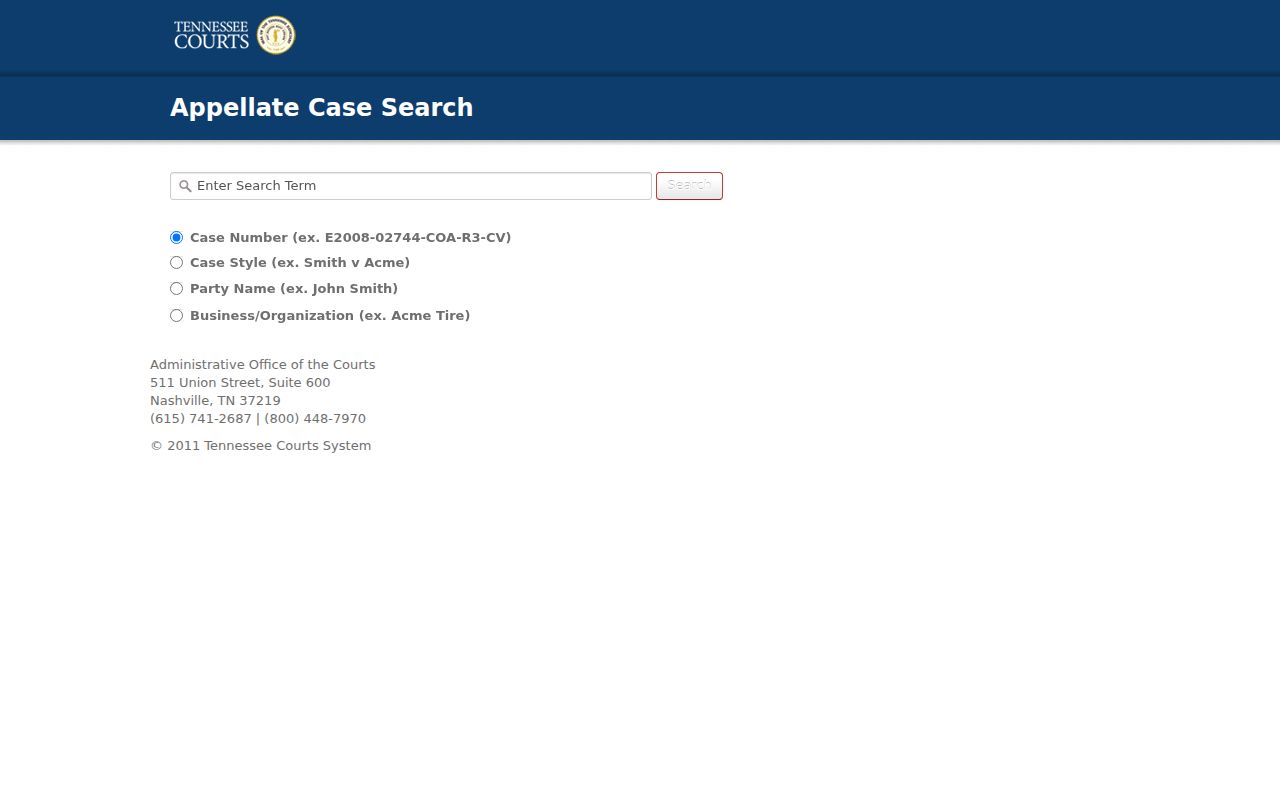
Use those paths to locate an appeal record, then check the trial-court field before treating it as a match for a local case.
Tennessee Trial Records Routes
Tennessee has no single public search for trial cases in all 95 counties. Participating counties use TnCIS Web Inquiry or another linked local system; some provide only an in-office terminal. A TnCIS result may show party name, role, case number, case type and subtype, filing date and case style. Detail tabs can add filings, attorneys, fees, additional parties, hearing dates and disposition. County participation and online date ranges differ, so a blank statewide appellate search says nothing about a county trial case.
An appellate result can confirm a procedural trail, but it does not establish where a party lives now. A visible result may include these fields:
- Appeal number and case style, plus the trial court, judge and trial case number.
- Parties, their roles, counsel and related-case references.
- Appeal, record and briefing milestones with dates.
- Decision date and type, disposition and closed date.
- Document-history event, date, filer and permitted PDF links.
- Record information such as technical-record or transcript volumes.
The official sample case detail displays those fields separately. Names or initials identify parties in that case, not a person's current residence.
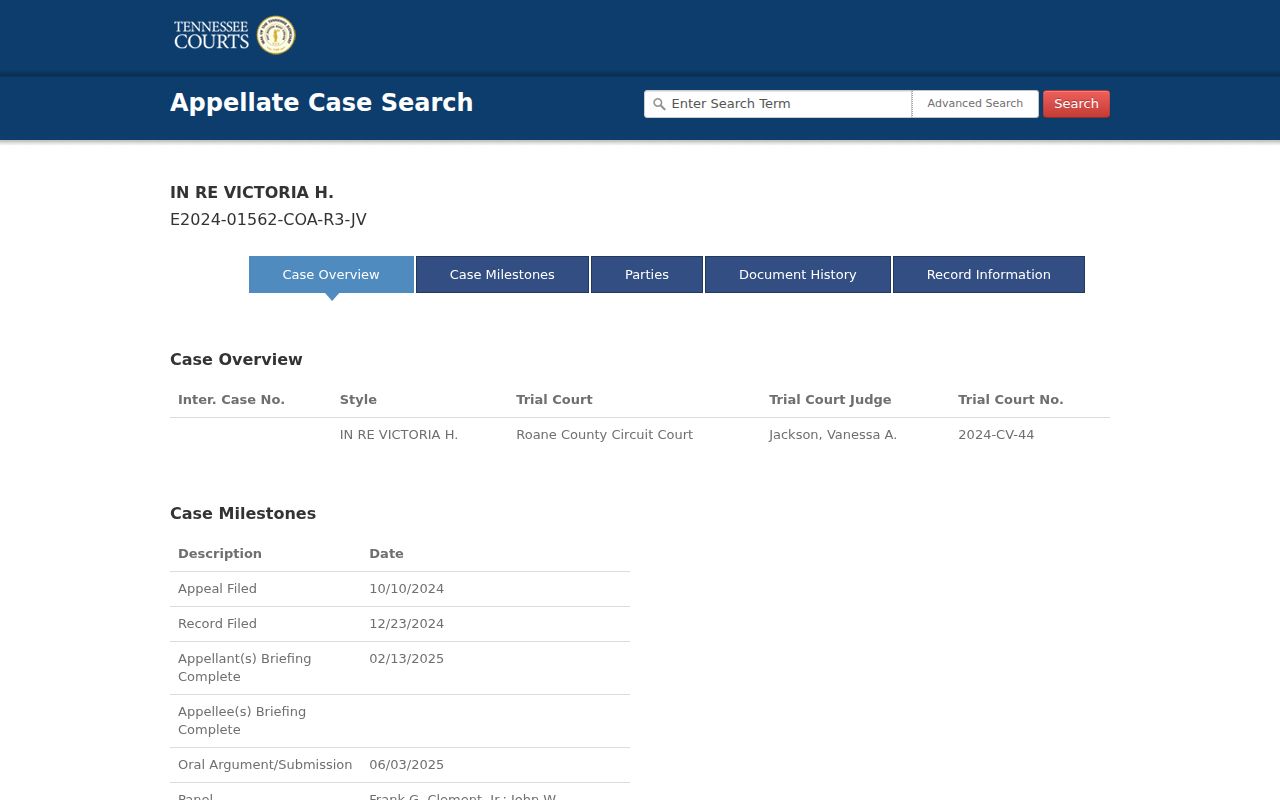
A visible appeal can confirm appellate history and a route to the trial court. It cannot replace the local clerk's file, and juvenile, adoption, sealed, expunged, victim-protected and restricted medical or financial material remains limited.
Tennessee Voter Lookup Fields
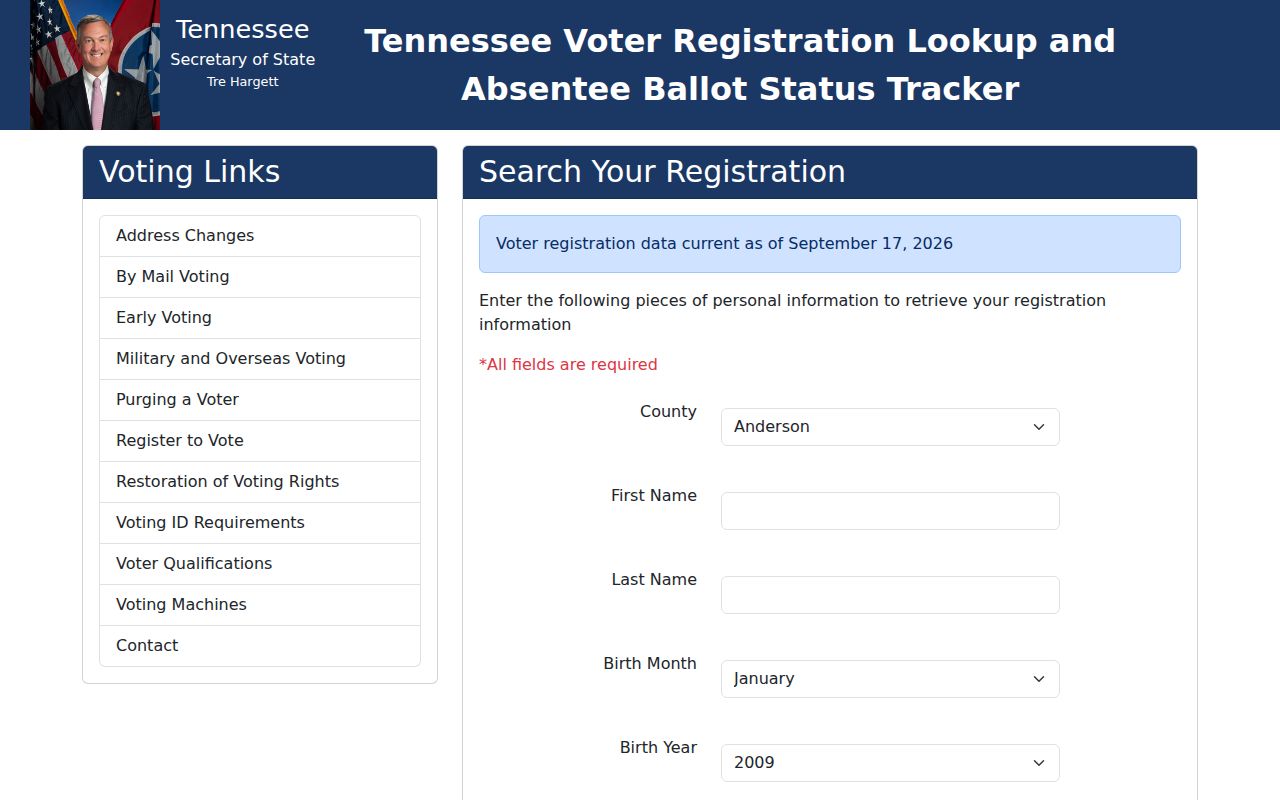
All five required fields on the statewide voter form must match the registration. A no-record message directs the user to recheck the entries or contact the local election commission. Birth month and year are match gates, not public birth fields. Public data can show status, address, precinct and district; voter history may show participation, never a ballot choice. Tennessee has no ordinary party registration.
| Required field | Form type | Search note |
|---|---|---|
| County | Dropdown | Select the Tennessee county tied to the registration |
| First Name | Text | Use the spelling on the voter registration |
| Last Name | Text | Use the spelling on the voter registration |
| Birth Month | Dropdown | Select the month requested by the form |
| Birth Year | Dropdown | Select the year requested by the form |
The state voter lookup page makes each of those five fields required before it returns a registration or absentee-status result.
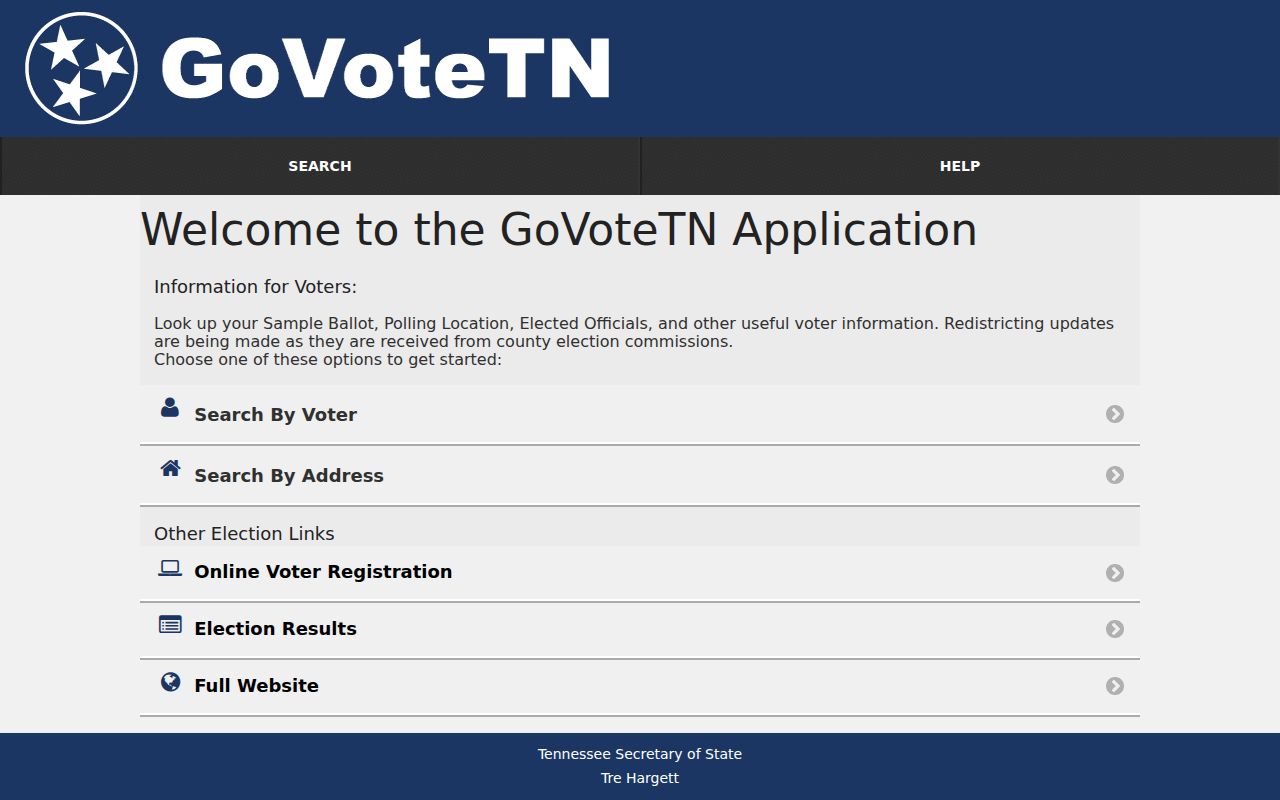
The GoVoteTN search page takes a separate route: search by first and last name with an optional ZIP, or by street address and ZIP. It can return a sample ballot, polling location, elected officials and districts. The image shows those name and address modes.
Public voter records may include name, registration address, status and district. Social Security numbers, driver-license or Department of Safety IDs, and specified absentee fields are withheld. A mismatch goes to the county commission, which supplies GoVoteTN data. Under T.C.A. § 2-2-138, the Coordinator of Elections or a county commission may provide a full list and voter history for no more than production cost. That file is separate from the public lookup. Ask for its current fields, price, delivery format and use terms; the public lookup does not post those details.
Confirming a Tennessee Resident
To verify a person, tie the name to a county and compare records from different offices. Do not end with one property, voter or court hit. Save the spelling, county, record date and link between the result and person. Keep a negative search too, since coverage and spelling can explain a no-match.
- Start with a county and the best known name form. Use the assessor to distinguish an assessed owner, parcel and mailing address from a street location. Treat the owner as one clue, not as every person at that address.
- Check the voter form only if the county, first name, last name, birth month and birth year are known. Compare the returned registration and district details with the other records, and ask the local election commission about a mismatch.
- Search the proper court level. For an appeal, use C-Track; for a trial, route to the county portal or clerk. Compare party role, case type, date, related person and disposition before linking two records.
- Use a vital index to test a family or event connection. If a certified copy is needed, apply through the office with the right to receive it and provide the required proof.
Two custodians usually make a stronger match than two screens from one system. A parcel plus court party, or a marriage index plus obituary, adds context. A business or license hit alone is weak evidence of residence. For a whole street, the Tennessee street directory follows the address records separately.
- Docket
- A court's case list and event record, with entries such as filings, hearings and decisions.
- Index vs image
- An index points to a record with selected names or dates; an image is a scan of the source document when the custodian makes it available.
- Certified copy
- A copy issued with the custodian's seal or certification for a use that requires an official copy.
Tennessee Vital Record Limits
Tennessee's Office of Vital Records holds birth, death, marriage, divorce and annulment records. Under T.C.A. § 68-3-205, birth events become public after 100 years; death, marriage, divorce and annulment records after 50 years. An index or verified fact is not a certified certificate. Current copies generally go to the registrant, spouse, child, parent, guardian or authorized representative; other applicants need proof of a legal, personal or property right. Cause-of-death copies have added limits.
The Nashville office accepts in-person applications at Andrew Johnson Tower, 710 James Robertson Parkway, first floor, Monday through Friday from 8 a.m. to 4 p.m. The listed phone numbers are 615-685-4700 and 615-741-1763. County health departments can issue statewide-registered birth and death certificates, not only events from their own county. Marriage and divorce certificates and verified facts use the state route, while the underlying local marriage record or divorce case may also be held by the county clerk or court clerk.
In person, bring the signed form and ID; the window accepts cash, check, card or money order. Mail a signed form with a signed-ID copy or notarization and payment by check or money order. Online orders go through VitalChek, the only authorized card vendor, which adds a fee; TDH does not take orders directly. Email routes handle issuance status and special services. A first or additional certificate and verified facts each cost $15, even when no record is found; supporting-document copies cost $5, opening a sealed file $30, paternity certificates $5, and delayed-certificate preparation $15. The June 2026 page listed same-day in-person and three-day mail or online times for no-change requests, 45 days for adoption or delayed birth, and two weeks for amendments. Times can vary.
Cause-of-death copies may require a qualifying parent, child or spouse, an executor, beneficiary, attorney or agency with proof, a court order, or a documented legal claim. The state submission instructions describe in-person, county-health, mail and online channels and link to the required forms. For older family work, TSLA and historical indexes may be a better start: statewide birth and death registration began in 1908, 1913 is missing from general statewide death registration, and broad compliance came by 1927. A marriage or divorce search may need one request for verified facts and another to the local clerk for the source record.
Tennessee Resident Heir and Birth-Parent Paths
An heir search is a county probate question. The Clerk & Master handles most probate and estate matters. A will, inventory, petition, deed recorded after a death, obituary and eligible death record may each add a different family link. Start with the county's probate index or court clerk; if the online docket is thin, ask the clerk about a public terminal, a copy request or the archive route. Names and addresses can appear in an estate file, but protected material remains closed.
Birth-parent records have a separate boundary. Tennessee adoption records are restricted. Use the official TDH adoption and certificate forms, and ask Vital Records to confirm any current registry or confidential-intermediary route and eligibility. The agency or court that holds the adoption file can explain its own process. Public records are not a way around a sealed adoption record.
For a former classmate, a yearbook, newspaper archive, public-library genealogy desk, university special collection or official archive can help re-establish a name or past community tie. An obituary or cemetery entry can point to relatives and a last place, but compare it with an official death index when one is available.
Tennessee License and Business Records
Business and license records are useful when the question concerns a named company, credential or public filing. The Secretary of State entity search accepts a business name or control number and can show entity type and jurisdiction, formation, current status, registered office and agent, annual reports and filing history. A copy can be requested with form SS-4461 through the Secretary of State's website, email or phone, then sent by mail or handled as a walk-in request; each document set costs $20. County-clerk assumed-name records and city business licenses are separate, local systems. A registered agent may represent several entities, and a registered office is not proof that the person lives there.
TDCI Verify lets a user search an individual or business name, a name within a license type, license number, city, Tennessee county or license type. It displays license, permit or registration status, expiration and public disciplinary actions, with daily updates. The TDCI license verification portal shows the search route; the image records the form's individual, business and license-type choices.
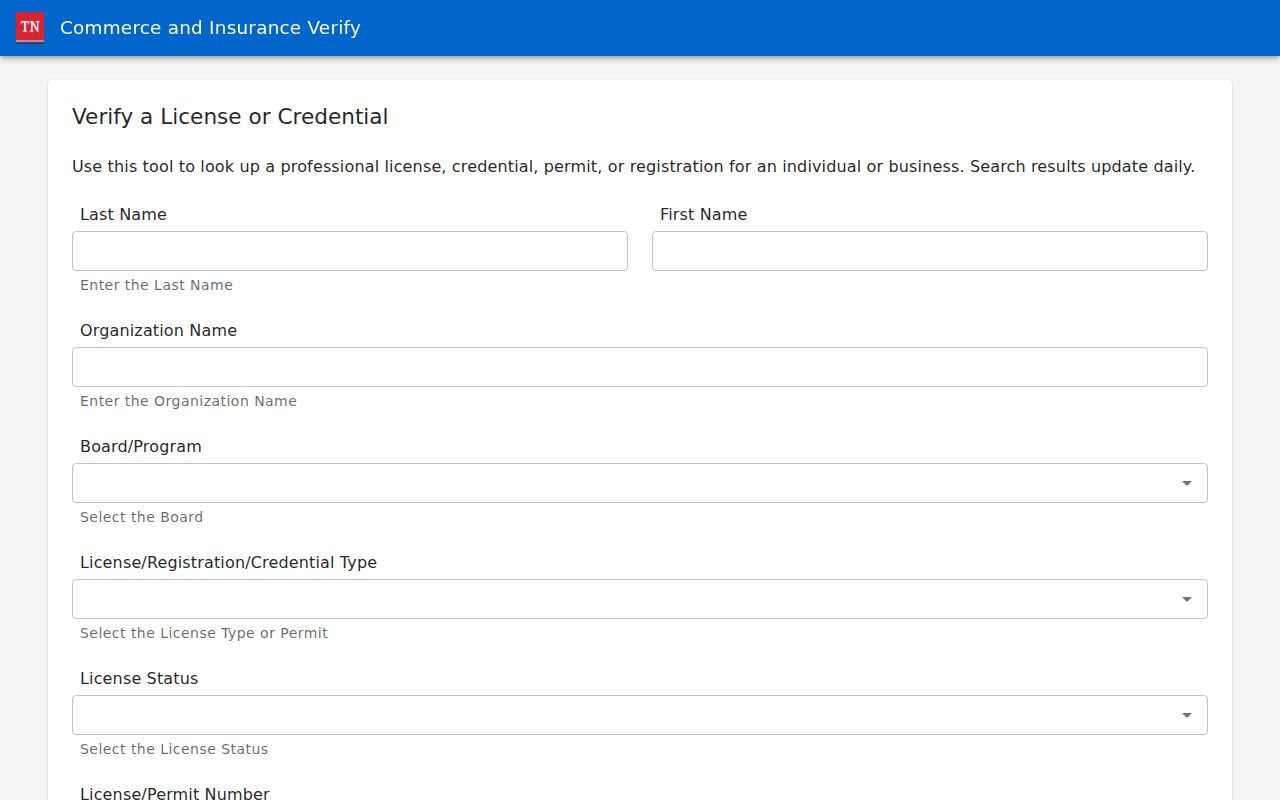
The screenshot helps separate a credential search from a home-address search. Health professionals have a separate TDH verification system with name, city, state, ZIP, profession and license fields. Both tools identify credentials, not a person's residence.
Tennessee Resident Records Requests
The Tennessee Public Records Act (TPRA), T.C.A. §§ 10-7-501 et seq., gives Tennessee citizens an inspection and copying right, subject to exceptions. There is no central TPRA repository: send a request to the government entity that holds the record and follow its posted public-records policy. An inspection request may be made in person, by phone, fax, mail, email or an agency portal; an office cannot force an inspection-only request into writing. A copy request may require a written form with enough detail for the custodian to find an existing record. A request form can ask for the entity, Tennessee citizenship, inspection or copy, delivery choice, record type, date range, search terms and signature. The law does not require an agency to create a new database or sort a list it never made.
If prompt production is not practical, the custodian must, within seven business days, provide the record, give a written denial and reason, or explain in writing how much more time is needed. Inspection is generally free unless another law applies. The standard OORC schedule lists 15 cents per black-and-white page and 50 cents per color page, with permitted labor, vendor or storage charges; an estimate comes before charges. A denial can be appealed in circuit or chancery court under T.C.A. § 10-7-505. The Office of Open Records Counsel can offer access guidance, but it is not a records-search service.
When an online court or deed index stops, use the AOC courthouse finder to locate the clerk, contact that office by phone or email, use its public terminal or counter, request a copy by mail, and ask whether an online portal accepts a detailed request. TSLA's county microfilm catalogs and local libraries can help with older court and deed material; the TSLA listed search fee is $5 for a Tennessee resident or $10 for a nonresident for a five-year span in one court and county. Keep the county, court, record type, name variants, date range and request mode together. That keeps a search traceable even when the answer comes from a paper index rather than a portal.
Tennessee Resident Lookup Limits
Public-record access does not erase record-by-record limits. TPRA exceptions in T.C.A. § 10-7-504 can close Social Security numbers, medical data, juvenile and adoption material, protected-victim information, confidential addresses and sensitive law-enforcement records. The federal Driver's Privacy Protection Act, 18 U.S.C. §§ 2721-2725, keeps personal details from motor-vehicle files out of ordinary name searches. Court files may be sealed or expunged, vital records have age and entitlement rules, and absentee applications contain private fields.
Safe at Home, run by the Secretary of State under T.C.A. §§ 40-38-601 et seq., gives eligible survivors of domestic abuse, stalking, human trafficking, rape, sexual battery or another sexual offense a substitute address at no cost. It does not erase older records or change an identity. The substitute address cannot be used for property-tax listing or recorded real-property documents, while program and voter information have separate confidentiality protections. Tennessee expanded home-address confidentiality in Public Chapter 620, effective March 27, 2024.
When a record is wrong, ask the custodian for its correction path: assessor for assessment data, election commission for registration, court clerk for a case file, TDH for a vital amendment, Secretary of State for a business filing, or the registering agency for a registry profile. Keep the date, page or case number and source. Tennessee's public-record privacy framework works through record-specific exceptions, not one universal deletion route for commercial profiles. A data-broker opt-out affects that provider's copy, not the government record beneath it; use each provider's own removal instructions and keep the receipt.
Lawful use. Use a Tennessee resident lookup for a lawful personal purpose and stop when a record is protected. Do not use names, addresses or record details to stalk, threaten, harass or intimidate anyone.