
Tennessee's Historical Directory Shelf
Tennessee has no single statewide city-directory run. The main collections are kept by local libraries and archives, with selected volumes also held by the State Library and Archives and the National Archives. Publishers changed between annual books, and a directory labeled for one city could reach nearby suburbs without covering the whole county. Start with the city and likely year, then check the holding institution's catalog before treating a missing volume as a gap in a family's record.
| Collection | Years | Where held | Access |
|---|---|---|---|
| Nashville city directories | 1853-2011; originals from 1869 | Metro Archives; Tennessee State Library and Archives (TSLA) digital links and microfilm | Local research room, microfilm, or selected scans. |
| Memphis and suburban directories | 1849-1994; suburban runs 1964-1994 | Memphis/Shelby County Room; Register and archive digital holdings | Library room and selected online or library-access collections. |
| Chattanooga city directories | 1871-1960; Hill City volume located for 1904 | Chattanooga Public Library Local History & Genealogy; Ancestry Library | Library and genealogy collection route; confirm the current guide. |
| National Archives selected runs | Circa 1930; city runs vary | National Archives | Search the city-and-year list. |
| State gazetteers and phone books | Gazetteer 1860-61; phone-book years vary | TSLA and major libraries | Catalog and local collection inquiry; not all are household directories. |
These dates describe collections located in the research, not a promise that every year survives. The source record does not give a complete list of missing annual volumes or a statewide publisher sequence. Check a title page, catalog entry, or staff note for the exact edition and imprint.
- 1849: the located Memphis city-directory run begins.
- 1853: Nashville's run begins; TSLA has a digitized segment through 1881.
- 1871: the identified Chattanooga run begins.
- 1904: a Hill City edition is located for Chattanooga.
- 1960: the identified Chattanooga run ends.
- 1994: the located Memphis run ends.
- 2011: the located Nashville run ends.
Nashville Directory Years and Search
Nashville Metro Archives lists the city run from 1853 through 2011. Original copies begin in 1869, while the earliest portion is available on microfilm; TSLA links a digitized run from 1853 to 1881. The first search method is important: Nashville directories from 1853 through 1909 are name-only, and volumes from 1910 onward support both name and street searching. Suburban directories appear from the 1950s.
Early Nashville books did not cover all of Davidson County, though some extended beyond the corporate city limits. A person outside the book's territory may be missing even when the name and year are right. Use the city label as a clue to the volume, not a fixed statement of municipal boundaries. The Metro Archives genealogy collection page lists its directory and related local-history holdings.
- For an 1853-1909 entry, begin with a person's name, initials, or spelling variant.
- For 1910 and later, test the name and street index; use the printed key to read the exact marks.
- For suburban addresses, check the separate suburban volume or section from the 1950s onward.
- Record the volume year and its coverage before comparing it with another household source.
The annual publisher varies, so note the title and imprint from the volume itself. A run's last year is not evidence that every earlier year exists on the shelf.
Note: The Nashville directory's city label can reach beyond municipal lines while still leaving parts of Davidson County outside its coverage.
Tennessee's Memphis City Directory Holdings
Memphis city directories cover 1849-1994, with suburban directories from 1964 through 1994. The publisher varies by run. The Memphis and Shelby County Room holds city and telephone directories, maps, newspapers, photographs, yearbooks, and local indexes. Its genealogy room route also includes microfilm and a large collection of family-history books. Ancestry Library is available on library computers or Wi-Fi, while access to some collections outside the building is limited.
The Memphis Library's home-research page describes the room's local sources and how they fit together.
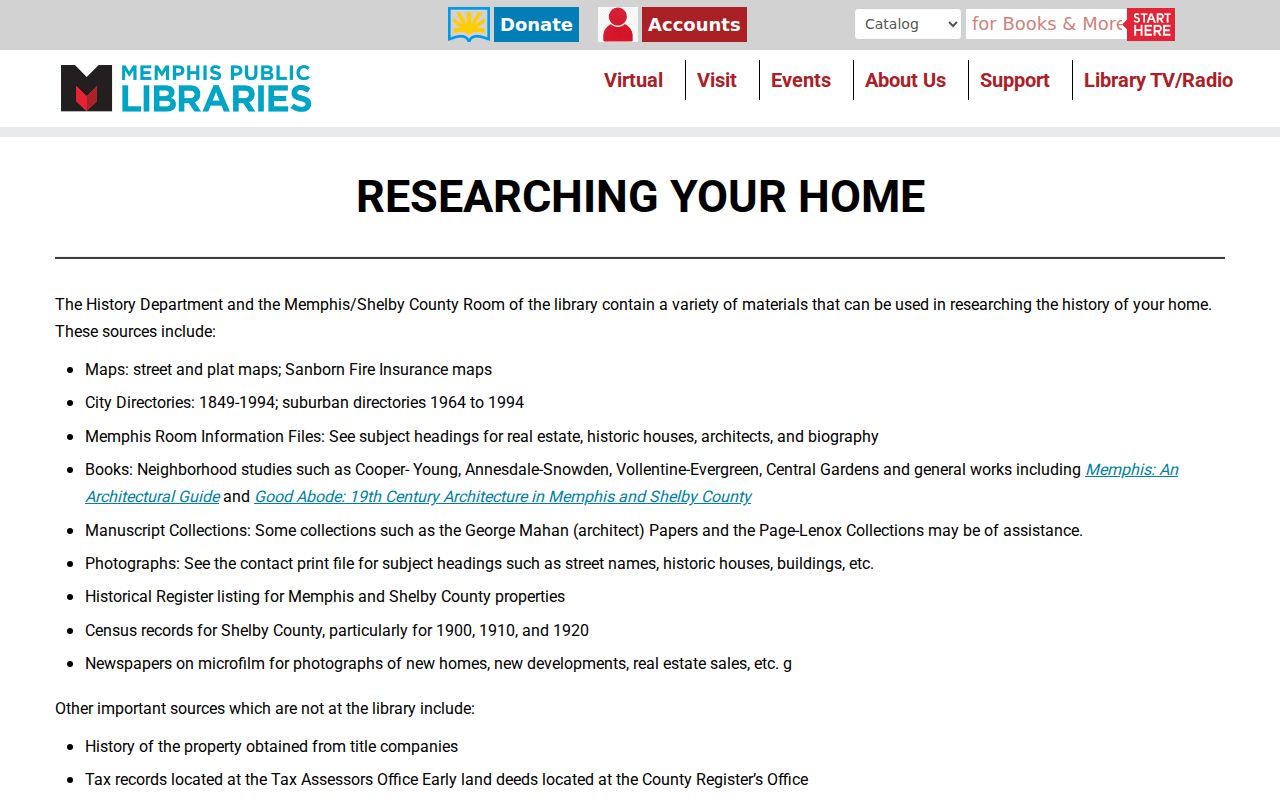
The room is at Central Library, 3030 Poplar Avenue. Its directories sit beside census, map, newspaper, and property-record routes, so a directory entry can be checked against a separate source rather than read in isolation.
Memphis-related records in the same room include indexed or microfilmed marriage, death, probate, church, cemetery, and funeral-home material. These collections have their own year ranges and custodians. Use a directory for a listed name and address, then confirm a major life event in the relevant local or state record.
Other Tennessee Directory Runs
Chattanooga Public Library's Local History and Genealogy materials include directories from 1871 to 1960, with a Hill City Directory volume for 1904. The library guide connects that run to maps, newspapers, and house-history work; the linked collection host may be unavailable, so confirm the current route with the library. Ancestry Library is another access path identified for Chattanooga directories.
The National Archives (NARA) holds selected city-and-year runs rather than a complete annual set for every Tennessee place. Its circa-1930 list includes Bristol volumes for 1929-1932 and 1934; Clarksville for 1911-1912, 1922-1923, and 1929; Johnson City for 1928, 1930-1933, and 1935; Knoxville for 1929-1931; and Nashville for 1928-1931 and 1933. NARA's city-directory list lets a reader check the precise city and year.
Some entries list a city or county beyond what the cover suggests. Johnson City's NARA listing includes Washington County. Always inspect the volume title page and location notes before assuming a directory covers only the modern city line.
Decode a Tennessee City Directory Entry
A directory entry is a compact set of labels. The exact fields and short forms depend on the year and publisher, so read the page image and its own abbreviation key. Nashville's local guide documents name, address, occupation, spouse, owner or renter marks, widow notation, business address, and later telephone clues in different volumes. Transcribe what the book prints before drawing a conclusion from a mark.
| Printed field | What it may tell you |
|---|---|
| Name | Listed person, often with initials or a spelling that can change by year. |
| Occupation | A historical label attached to the entry in that volume. |
| Address | House number and street; use the year's street-name and number system. |
| Spouse or widow note | A family clue, sometimes shown in parentheses or a short notation. |
| Owner or renter mark | A symbol some volumes use; check the key before reading it. |
| Telephone or business address | May appear in later phone books or separate business sections. |
A spouse in parentheses or a widow notation can suggest the next name to search, but the notation remains a clue from that edition. An owner mark is not a deed, and a printed address is not a boundary survey.
- Criss-cross directory
- A street-order section that lets a reader start with an address and see the listed name.
- Householder index
- An index that points from a household name to its entry in the volume.
- Abbreviation key
- The volume's guide to its short forms and marks; use that edition's key, not a later book's.
- Owner or renter mark
- A publisher's notation in some volumes, not a deed or a complete household count.
Note: Read the volume's own key before decoding a symbol, since a later publisher or year may use the same mark differently.
Tennessee TSLA and Local Directory Access
Tennessee State Library and Archives links digitized Nashville directories for 1853-1881 and holds county microfilm inventories for deeds and other records. Check the catalog for the exact city and year before relying on a scan. The broader Digital Tennessee collections include government publications, newspapers, maps, and community material, which can add context around a directory entry.
Local libraries remain central. Metro Archives describes in-person house-history research and staff help; Memphis places directories beside local maps, newspapers, census, and deed routes; Chattanooga lists a directory and house-history collection but the guide host needs confirmation. A local-history desk can tell you whether a volume is on an open shelf, on microfilm, or available through a library account. Ask for the city, year, collection title, index style, and reproduction rules.
For older county records that are not a city-directory volume, the TSLA county microfilm catalog can point to deeds, court minutes, probate, and marriage records. A book in a state archive is not necessarily digitized or searchable by street. Keep the directory search separate from the land-record search until a name, address, or legal description connects them.
Tennessee Street Renumbering in Directory History
Tennessee directories can preserve a street name that no longer appears on a current map. In late 1904, Nashville changed major downtown names west of the Cumberland River to numbered avenues: Market became 2nd Avenue, Front became 1st Avenue, and College became 3rd Avenue. A Nashville library history account follows Market Street and its name change through local records.
Memphis offers a second address clue. A building recorded as 338 Main in the old system became 77 S. Main in a 1905 renumbering. The Memphis library's history record connects the old and new numbers. Search both forms, then compare the lot description or map before treating them as one place.
These changes are a useful local quirk, not a statewide renumbering date. Tennessee assigns road names and property numbers through local authority, and a nearby municipality may use a different history. Record the city and year with every directory citation.
Sanborn Maps Beside Tennessee City Directories
Sanborn fire-insurance maps can help place a directory address on a block. Library of Congress Nashville holdings include an 1888 volume, a 1914 volume, and later mapped or republished material. Its catalog describes the 1888 set as 83 images and public domain. Memphis records include a 1907-1952 republished volume. These maps can show footprints, building materials, stories, outbuildings, and lot context.
Compare the 1888 Nashville Sanborn volume or a Memphis Sanborn record with the nearest directory year and a deed or plat. A map can show how a block changed; it is not a resident roll and does not establish who occupied a building.
Read the map as place evidence. Match the street and lot first, then use directories or deeds to identify a name tied to that place and time.
Note: Sanborn examples document structures and lot patterns, not household names or a present-day parcel boundary.
Check Tennessee Directory Coverage
A city directory can be a commercial directory, telephone book, gazetteer, or a reverse directory, and each type answers a different question. A business listing is not the same as a household entry. Later books may split residential and business listings, while suburban streets may sit in a separate section. Tennessee's publisher and coverage notes change by city and year, so keep the title page and index method with the result.
When a name is absent, test initials, spelling, married or widow names, a nearby year, and a neighboring city or suburb. Nashville's early volumes are name-only, and the city run did not cover all of Davidson County. Memphis's suburban volumes begin separately in 1964. Chattanooga's located run ends in 1960. Those scope facts explain why one search can miss a person even when another source places the household nearby.
Do not read a disappearance as proof of a move or death. The person may have left the book's coverage, appeared under another name, been omitted by the publisher, or fallen in a year not held locally. Check an obituary index, census, cemetery file, or other dated source before closing the trail.
Trace a Tennessee Household Across Years
Use the name index first when it is available, then follow the same person across annual volumes. Keep a small record of the spelling, address, spouse notation, printed occupation, and volume year. A householder index or street-order section may help when the question begins with a place. Link a directory address to a parcel only after checking the deed description or map. The modern parcel workflow is covered on the Tennessee street directory page.
- Find the first known name in a city and year that falls within the collection's coverage.
- Copy the entry as printed, including the full address and any household notation.
- Search nearby years and note each move, changed spelling, spouse clue, or gap.
- Use a street-order section when the volume supports address-first searching.
- Pair the directory years with federal census years such as 1900, 1910, 1920, 1930, 1940, and 1950.
- Check deeds, maps, obituaries, cemetery records, or local indexes for a separate confirmation.
The National Archives' census research page explains access to released federal schedules. A census is a dated household snapshot, not a yearly address record. Use it to fill a decade-sized gap, then return to the directory or local record for finer timing.