
Finding Tennessee Residents
Tennessee has no master list of everyone who lives in the state. Property, voter, court, business, and vital records sit with different keepers, and each source answers a narrower question. Start with the county and the record type. A parcel search can identify an assessed owner, but it does not name everyone in a home. A voter match confirms a registration record, not current occupancy. A directory or obituary may add an older address or family link, but its date and coverage matter.
Move through the records in a set order. Keep the search date, county, spelling, and result number so a same-name match can be checked later.
- Choose the county tied to the person, address, or event. Tennessee has 95 counties, and many local offices keep their own indexes.
- Check the assessor for owner, parcel, situs address, and tax-mailing address. Treat owner data as property evidence, not a household list.
- Use the voter lookup only with its required identity fields. For an address or ZIP, GoVoteTN can show a ballot, polling place, or district.
- For deeds or a local case, route to the county Register of Deeds or the court clerk. The Tennessee street directory follows the address-keyed records; no statewide deed index or complete trial-court search exists.
- For older residents, use library and archive catalogs. If an existing record is not online, make a focused request to its custodian.
- Parcel
- A mapped piece of land with a county identifier and assessment record.
- Situs address
- The physical location of the property, which may differ from the owner's mailing address.
- Index
- A finding aid that points to a record. It may not include the full document image.
- Criss-cross directory
- A directory arranged by street address, often paired with a name or occupation.
Tennessee Offices That Keep Resident Records
State offices keep vital certificates, statewide indexes, licenses, and selected court records. County offices hold deeds, assessments, local voter files, trial-court records, probate, permits, and jail information. A search should follow the record to its county or state custodian instead of treating every result as one central profile.
Tennessee State Library and Archives
County microfilm, genealogy indexes, older court and deed records, and digitized collections.
Tennessee Vital Records
Andrew Johnson Tower, first floor, 710 James Robertson Parkway, Nashville, TN 37243.
615-685-4700 / 615-741-1763
Monday to Friday, 8 a.m. to 4 p.m.
Tennessee Voter Lookup
The state form checks a registration record. County election commissions hold the local file and resolve missed matches.
State elections contact: 1-877-850-4959
See the required search fields below.
County Registers of Deeds
Each county keeps its own deed index and recorded instruments. Older county deed books may also be listed in TSLA microfilm catalogs.
For property and trial records, start with the county. TPAD and state court tools help route a search, but the county Register, assessor, election commission, or clerk remains the keeper of many original records.
Where Tennessee Resident Searches Split
The Comptroller's Tennessee Property Assessment Data portal covers 86 counties that use the IMPACT assessment system. It searches by owner, property address, or parcel ID, with advanced filters for subdivision, classification, sale date, control map, group, and parcel. The nine counties routed to other assessor systems are Chester, Davidson, Hamilton, Hickman, Knox, Montgomery, Rutherford, Shelby, and Williamson. A blank TPAD result in one of those counties is a routing issue to check, not proof that no record exists.
Parcel mapping has a related but different boundary. The TNMap Property Viewer excludes Bradley, Davidson, Hamilton, Knox, Montgomery, Rutherford, Shelby, Sumner, Williamson, and Unicoi from its central view. Use the local assessor or GIS link for those counties. The statewide handoff is useful, but it does not erase the local layer or make owner data a list of every person at an address.
Search the physical address, owner name, and parcel number as separate fields. The tax mailing address can differ from the place on the map. That distinction matters when a business, estate, or agent receives the bill.
Tennessee Election Lookup Fields
The Tennessee Voter Registration Lookup is a one-person match. The user must enter all five fields shown below. A no-record message directs the user to check the spelling or contact the county election commission.
| Field | What to enter | Why it matters |
|---|---|---|
| County | Select a Tennessee county | Local election commissions supply the registration data. |
| First name | Name as registered | Exact spelling can affect the match. |
| Last name | Name as registered | Try a known spelling variant if needed. |
| Birth month | Select month | Required identity check. |
| Birth year | Select year | Required identity check. |
A voter match is one part of an individual identity search. Compare it with a separately held, dated record before treating the match as current. Contact the local election commission when a match is missing or an address needs correction.
Tennessee Court Records by Level
Choose the court before searching a name. The state's Public Case History portal searches Supreme Court, Court of Appeals, and Court of Criminal Appeals matters when the record was filed after September 1, 2006. Its required search term can be a case number, case style, party name, or business or organization. Results are current through the prior business day.
An appellate record may show parties and counsel, the trial court, appeal milestones, decision, disposition, permitted document links, and record volumes. It does not replace the trial docket or make confidential juvenile details public. For a trial case, use the county court's local search if available, then contact that court clerk for older files, public-terminal access, or a copy request.
The AOC courthouse finder routes by county and court type. Municipal, General Sessions, Circuit, Criminal, Chancery, and Juvenile matters do not share one complete statewide docket. A portal with no result may not cover that court or date range.
Tennessee's Current Resident Records
Current records can support a careful identity check, but none is a complete directory of households. Each source records a different event or relationship. The right match joins two independent records with the same county, date, address, parcel, or family link.
| Record source | What it may confirm | Keeper and access | Limit |
|---|---|---|---|
| Assessor parcel card | Owner of record, situs, mailing address, parcel, sale or assessment clues | TPAD or the county assessor | Not a list of occupants |
| Voter lookup | Registration match, status, or district | State form and county election commission | One-person search; protected data stays closed |
| Deed index | Names tied to a transfer and legal description | County Register of Deeds | No common statewide address search |
| Vital record index | Event name, date, place, or family link | TDH, TSLA, or a genealogy index | Current certificates have eligibility rules |
| Unclaimed property | Possible owner, last-known address, holder, and claim reference | Tennessee Treasury's free claim search | Address may be old |
For a current parcel, compare the assessor card with the deed rather than assuming that the owner lives there. A certificate or docket index can confirm an event, while the underlying record may have separate access rules.
The Tennessee Treasury's ClaimItTN search can return an owner or co-owner name, last-known address, holder, amount, property ID, and claim route. The address may be old, so it is one dated lead to compare with a second source.
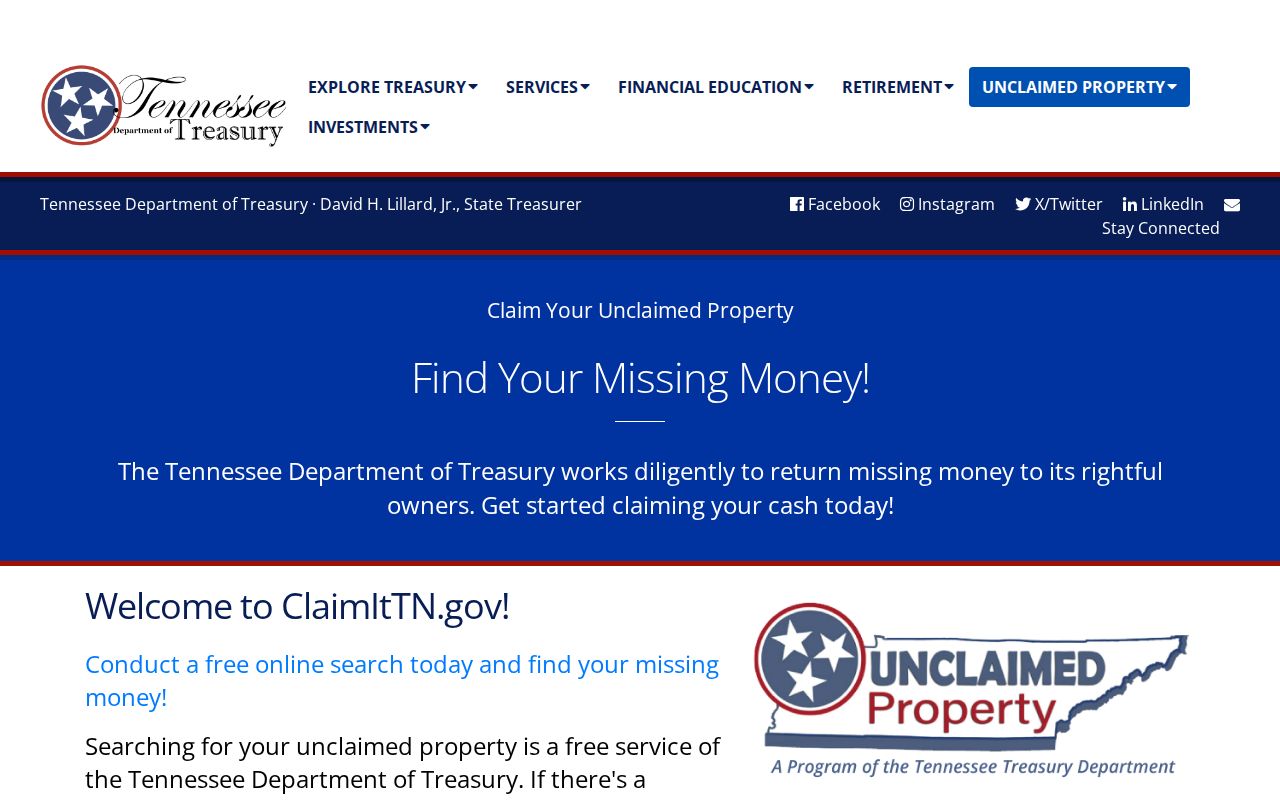
The result view helps a researcher check whether a claim belongs to the right person. The claim process may ask for identity and supporting documents that are not public search fields.
Requesting Tennessee Public Records
The Tennessee Public Records Act gives Tennessee citizens a right to inspect or copy many existing government records, subject to exceptions. There is no single state portal that holds every county file. Send a request to the agency or clerk believed to keep the record, and describe the record type, county, date range, names, address, or parcel number as precisely as the existing material allows. A custodian does not have to create a new resident list or sort records into a database that does not already exist.
An inspection request may be made in person, by telephone, fax, mail, email, or an agency portal. A copy request may need to be written or placed on the office form. If prompt production is impracticable, the custodian must provide the record, a written denial, or a written explanation and reasonable time estimate within seven business days. The standard OORC schedule generally lists 15 cents per black-and-white page and 50 cents per color page, with permitted labor or outside-vendor charges in some cases.
| Route | What it can do | What it cannot promise |
|---|---|---|
| Official custodian | Find an existing file, inspection copy, or certified record | A new statewide roster or a search across offices |
| Library or archive | Search a catalog, index, microfilm, or local collection | Current status beyond the collection's dates |
| Commercial people-finder category | Offer a compiled lead from mixed public and commercial data | A custodian-certified fact or a guaranteed current address |
A narrow request is easier to route than “all records about a person.” Name the county and office, say whether inspection or a copy is sought, and ask for the date range or record number when known. A compiled commercial result may be stale or join two people with similar names. Use an official record to verify a lead.
Tennessee Resident Address Privacy
Some records are closed or altered to protect a person. Tennessee's Safe at Home Address Confidentiality Program offers an eligible participant a substitute address at no cost. It covers people affected by domestic abuse, stalking, human trafficking, rape, sexual battery, or another sexual offense, and can include minor children. The substitute address does not delete older records and cannot be used for property-tax listing or recorded real-estate documents.
Public voter records leave out Social Security numbers and driver-license or Department of Safety ID numbers. Absentee applications hold more protected fields. Federal law restricts personal information from motor-vehicle records. Vital certificates, juvenile and adoption files, sealed cases, and protected-victim details have their own limits. A blank result may reflect a privacy rule, not an empty record.
People who need address protection should use the proper agency process. Do not try to infer a substitute or protected address from another person's records.
Tennessee Custody Records Have Limits
The Tennessee Sex Offender Registry is a public safety resource, with profiles supplied by registering agencies and a daily update notice. It warns that threats, intimidation, stalking, or harassment can lead to prosecution or civil liability. A profile should be read with its view date and agency contact, not treated as a guarantee of current accuracy.
The image below comes from the TBI registry search and shows its public-use notice.
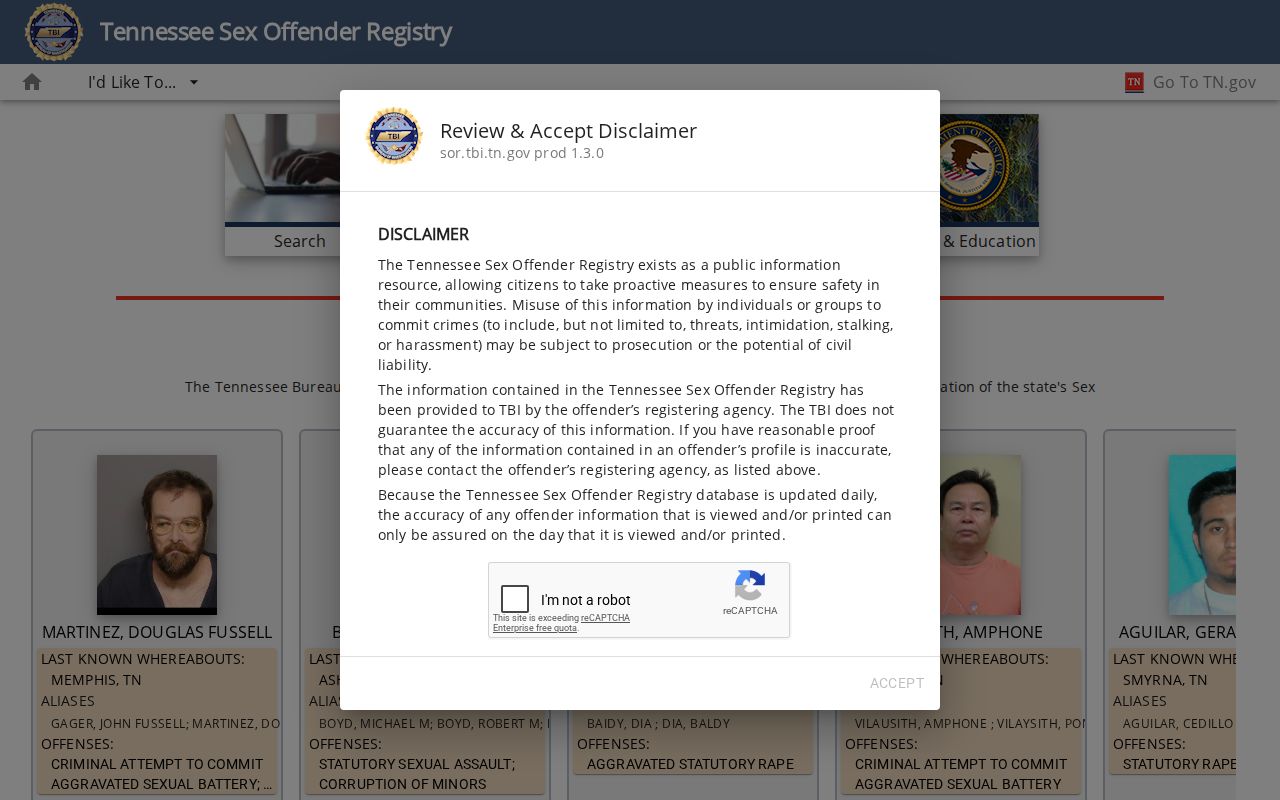
The Department of Correction's FOIL tool is a separate search for state felony offenders who are or have been in TDOC custody. County jail bookings remain with local sheriffs, and a no-result page does not cover every court or agency record. For a custody concern, contact the listed agency to confirm the current status and update schedule.
Libraries Beyond Tennessee Portals
Local libraries often hold records that a statewide search cannot show. The Nashville Metro Archives genealogy collections include city directories, local birth and death records, marriage indexes, court material, cemetery records, and naturalization material. Memphis libraries also hold older directories, maps, census, newspapers, deeds, and tax material.
At the state level, TSLA microfilm catalogs and the linked county inventories point to older books, vital records, and digitized material. Ask a library desk for the collection title, dates, index style, and whether a remote lookup is available before assuming a scan is online.
A city directory can connect a name to a past address, while a census can show a household at a later or earlier date. Neither source proves a person's current residence. The historical shelf and its year-by-year collections are described on the Tennessee city directory page.
Tennessee's Gaps and Address Changes
Not every lost resident record can be restored through a modern search box. Tennessee's federal 1790 population schedules do not survive. Hamilton County's 1910 courthouse fire damaged many records, including antebellum will books; former James County had courthouse fires in 1890 and 1913, and its surviving records returned to Hamilton County after James County ended in 1919. Tax lists, deeds, church registers, land grants, and newspapers can fill parts of the trail.
The WPA Historical Records Survey of 1935 to 1943 documented Tennessee county deeds, estate records, land surveys, wills, civil court, and vital records. TSLA's county microfilm has older books for varying years. These finding aids help locate a collection, but an index entry is not the original record.
Addresses also change. Nashville renamed several downtown streets in late 1904: Market became 2nd Avenue, Front became 1st Avenue, and College became 3rd Avenue. In Memphis, a documented 1905 renumbering changed 338 Main to 77 S. Main. Search both versions when an older directory or deed does not match a current map. County, city, postal, and parcel lines may also differ.
Historical Tennessee Resident Directories
Tennessee has no one statewide city-directory run. Nashville's collection spans 1853 to 2011, Memphis directories span 1849 to 1994, and Chattanooga volumes cover 1871 to 1960. Those shelves sit with local libraries and archives, not in one central index. Nashville volumes before 1910 are name-only; later volumes can support an address search. Suburban coverage and annual gaps still matter.
A historical directory may list a name, address, occupation, spouse, widow notation, or owner/renter mark, depending on the volume. Read its title page and abbreviation key. Pair an entry with a census, deed, obituary, or map before treating it as a household history. TSLA holds telephone-book and local-record collections too, but exact statewide telephone-year runs were not located.
The 2025 Tennessee Deed-Mailer Warning
On October 30, 2025, the Tennessee Attorney General warned about mailers offering deed copies for $89. The release said county Registers of Deeds charge cents per page and that nearly 4,000 consumers received restitution checks in a related case. An uncashed restitution check was moved to the state's unclaimed-property system.
Before paying a mailer, find the correct county Register through an official county source and ask for its copy process. The deed itself is held locally. A name search at ClaimItTN can check for a restitution payment, but its last-known address is not proof of where someone lives now. The warning is a useful reason to verify the office and fee before sending money.