
Tennessee Previous Residents: Era Sources
A Tennessee address has no single statewide history file. A parcel is a mapped piece of land; its situs is the physical street address, while the mailing address is where tax notices go. A legal description uses lot, tract, or boundary wording to identify land in a deed. The useful source depends on whether the question is about title, a past household, the building itself, or a death in the family. The table keeps those record roles separate and shows where a researcher can continue when a web index ends.
| Source | Years Located | Where Held | What It Shows |
|---|---|---|---|
| County deed indexes | Online years vary by county; no statewide cutoff | County Register of Deeds; State Library & Archives microfilm | Grantors, grantees, legal descriptions, recorded transfers |
| Nashville deed indexes | 1784-1924 microfilm; original books to around 1960 | Metro Archives, Register, State Library & Archives | Direct and reverse indexes, parcel history |
| Nashville city directories | 1853-2011; address search from 1910 | Metro Archives and TSLA | Annual names and address links; early volumes are name-only |
| Memphis directories and deeds | Directories 1849-1994; deed indexes earliest-1933 on microfilm | Memphis library, Shelby Archives, Register | Address entries and the older land index |
| Chattanooga directories | 1871-1960 | Chattanooga Public Library; Ancestry Library | Historical names and address clues |
| Federal census | 1790-1950 released; Tennessee's 1790 schedules did not survive | National Archives and library databases | Household, age, relationship, birthplace, and enumeration district |
| Sanborn maps | Nashville 1888-1957 examples; Memphis 1907-1952 examples | Library of Congress and local libraries | Building footprint, materials, stories, and lot context |
For the newest ownership link, begin with the county assessor and Register of Deeds. For an older household, a city directory or census is usually more useful. Maps and permits help date a structure, but they do not name everyone who lived inside it.
Tennessee Deeds for Previous Residents
Tennessee has 95 county Registers of Deeds and no common statewide deed-search portal. Remote indexes and images differ by county. Identify the parcel's county, then use the Tennessee state directory or county site to find the Register and its online years. A failed statewide property search can be a routing issue: the state assessment service covers 86 counties and links the other nine to local systems.
When the web view stops, ask whether a public terminal shows more fields, then try the counter or call the county office. Offices may accept mail, email, or an online request; a Tennessee Public Records Act request can seek an existing record, but cannot make a custodian create an address history. If prompt production is impracticable, the custodian has seven business days to provide the record, a denial, or an explanation of the time needed. For older material, check county deed books and archives, the Tennessee State Library & Archives (TSLA) county microfilm catalog, and digitized Tennessee collections on FamilySearch. TSLA deed searches use name, county, and a five-year span, not street address.
Keep the request narrow: give the county, parcel or legal description, names already found, and approximate date range. Ask for the index entry first if the instrument number or book and page are not known. Copy and certification charges vary by county, so confirm the current schedule with the office before ordering.
Trace Previous Residents Through Tennessee Deeds
A deed trail follows ownership backward, not a complete list of people in a building. Use the assessor's current owner and parcel details as the bridge into the county Register's direct and reverse indexes. Then compare the deed's legal description with the parcel card before treating two entries as the same land.
- Record the current assessed owner, parcel ID, situs address, and exact legal description from the county assessor or Tennessee Property Assessment Data (TPAD).
- Search the current owner as grantee in the county Register's index for the likely purchase period, using the parcel or lot details to check a match.
- Open the deed and note the grantor, grantee, instrument number or book and page, recording date, deed type, and legal description.
- Search the grantor as a prior grantee, then repeat the deed-and-index step to move farther back.
- Compare subdivision, lot and block, tract name, and neighboring grantors when an address or person name changes.
- At the portal's cutoff, continue with the county counter, deed books, microfilm, TSLA, or county archives.
- Grantor and grantee
- The grantor gives or conveys an interest; the grantee receives it.
- Chain of title
- The linked set of recorded transfers used to follow ownership for one parcel.
- Legal description
- The lot, tract, or boundary wording that identifies land in a deed more precisely than a changing street label.
- Criss-cross directory
- A reverse directory that starts with a street address and points to the names printed for that place.
- Enumeration district
- The area assigned to a census taker; historical census addresses do not always match a modern street label.
An index entry is a pointer, not the full instrument. Read the deed and compare its description before linking two owners to one parcel.
Tennessee Previous Residents and Street Changes
Old street names and house numbers can make a sound record trail look broken. In late 1904, Nashville changed downtown names to numbered avenues: Market became 2nd Avenue, Front became 1st Avenue, and College became 3rd Avenue. A directory or deed written under the older name may not appear under the modern address alone, so search both labels and use the legal description or a plat, the recorded map of lots and boundaries, to confirm the location.
Memphis had a separate building-number change in 1905. A documented address shifted from 338 Main under the older system to 77 S. Main. This is a concrete reason to check old directories, maps, and deed descriptions together rather than assuming that a number mismatch points to a different parcel. Other Tennessee counties have their own local street and parcel histories; these two examples should not be applied statewide.
The practical comparison is simple: a modern parcel card follows today's situs address, while an old deed or directory may follow a prior name or number. Preserve both forms in your notes, along with the county and record date.
Tennessee Previous Residents: Library Clues
Local-history staff can help bridge records that are filed by a name, year, or former street rather than a current address. Nashville Metro Archives' Research Your Old House guide explains an in-person path through directories, deed indexes, plats, and Sanborn maps. The guide says staff can help, but the archives does not hold ordinary individual-home blueprints, permit files, renovation plans, or photographs unless a home is historic.
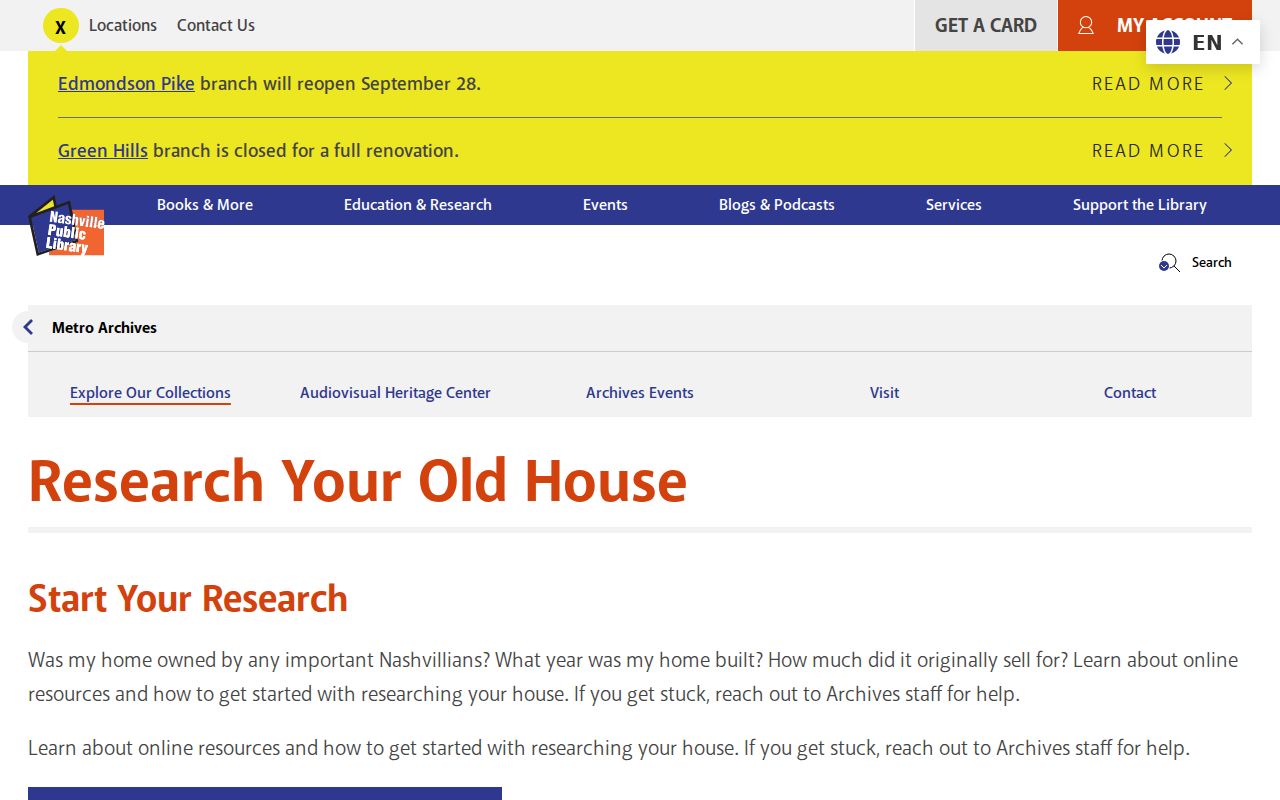
The image shows the Nashville house-history guide, a starting point for earlier residents rather than a statewide deed index. Memphis Public Libraries' home-research material points to directories, maps, census, newspapers, tax records, and early deeds. Chattanooga's 1871-1960 directory run is a local-history resource, with maps and newspapers as companion sources. For any archive, ask for the collection title, years, index style, reproduction rules, and whether a remote lookup is offered.
These library routes are useful after a county search because a printed guide or finding aid may name a microfilm reel or old county record series that a portal does not expose.
Tennessee Directories for Past Residents
Directories supply dated address clues between census years, but their coverage and search method change by city and volume. Nashville's run spans 1853-2011: early volumes are name-only through 1909, and street-address access begins in 1910. Memphis directories run from 1849-1994, with suburban volumes from 1964-1994; Chattanooga's located run is 1871-1960. The Tennessee city directories page describes those collections as shelves and indexes; this page uses them to follow one address through time.
- Choose an address and year, then confirm the city volume actually covered that place. Early Nashville editions did not include all Davidson County, even when they reached beyond the city limits.
- For an address-first search, use a reverse or criss-cross directory when available. If the edition is name-only, begin with a person already tied to the address or ask library staff about a street index.
- Record the exact name, address, spouse or household notation, and volume year. Check the title page and the volume's own key before expanding an abbreviation.
- Compare the entry with the closest released census year, such as 1900, 1910, 1920, 1930, 1940, or 1950, then test a deed, obituary, or plat for another link.
The National Archives census collections can show household members and relationships at enumeration, but not an exact modern street address in every year. Tennessee's 1790 schedules did not survive, and 1950 is the latest released under the 72-year rule. A missing directory entry is not proof that a house was empty: a volume can omit a suburb, have an annual gap, use a changed street label, or index a name differently.
Tennessee Maps for Past Residents
Fire-insurance maps help date the physical setting around an address. Nashville examples include maps from 1888, 1897, December 1906 for the central business district, 1914, 1931, and republished 1951/1957 material. Memphis examples cover 1907-1952. A sheet can show a footprint, construction material, stories, outbuildings, lot shape, and nearby streets. It does not name the people who lived there.
Pair a map year with a directory entry, deed, permit, or census schedule. The map can test how a building or block changed; other sources carry names and transfer dates. View the 1888 Nashville Sanborn volume or the Memphis Sanborn volume covering 1907-1952 through the Library of Congress, and ask a local library about its own map holdings.
Maps also help when an address changed. A road name, lot line, or neighboring parcel can connect an old directory label to today's parcel, but the recorded deed remains the source for legal title.
Tennessee Previous Residents at the Endpoint
Past residents can leave a trail after the address link ends. Obituaries, funeral-home records, cemetery indexes, and local newspapers may identify relatives, a last place, or a date that helps distinguish two people with similar names. Probate files and wills can connect a deceased owner to heirs or explain a transfer that does not look like an ordinary sale. These records add family context; they do not establish who occupies an address today.
Nashville Metro Archives lists local wills, cemetery records, court minutes, and birth, death, and marriage indexes alongside its directory collection. The Memphis History Department holds indexed and microfilmed marriage, death, probate, church, cemetery, and funeral-home materials. The TSLA genealogy indexes add statewide search routes. For a recent death certificate, check copy rules with the Tennessee Office of Vital Records; current records are restricted.
County record loss can also change the endpoint. Hamilton County's 1910 courthouse fire damaged records, and former James County had fires in 1890 and 1913. The WPA Historical Records Survey from 1935-1943 documented Tennessee deeds, wills, court, land, and vital records, so its county inventories can point toward substitute sources where a local series is incomplete.
Personal research. Use these records for family and house history, genealogy, or personal curiosity. Respect private information, and do not use a record trail to stalk, harass, or intimidate anyone.